



HOW TO REPORT A STRANDING
Why do we need a strandings network?
Unfortunately, cetaceans regularly strand around the coast and information received on stranded animals can provide an accurate picture of what species are found in UK waters and show local and seasonal distribution. Strandings that undergo post-mortem examination provide us with valuable information on causes of death, disease, contaminants, reproductive patterns, diet and also useful pointers to the general health of the populations living in the seas around our coasts. This provides useful baseline data to help detect outbreaks of disease or unusual increases in mortality.
IF YOU FIND A STRANDED MARINE ANIMAL, PLEASE CONTACT THE RELEVANT AUTHORITIES:
Unfortunately, cetaceans regularly strand around the coast and information received on stranded animals can provide an accurate picture of what species are found in UK waters and show local and seasonal distribution. Strandings that undergo post-mortem examination provide us with valuable information on causes of death, disease, contaminants, reproductive patterns, diet and also useful pointers to the general health of the populations living in the seas around our coasts. This provides useful baseline data to help detect outbreaks of disease or unusual increases in mortality.
IF YOU FIND A STRANDED MARINE ANIMAL, PLEASE CONTACT THE RELEVANT AUTHORITIES:
| FOR LIVE STRANDINGS | ||
| England & Wales: | RSPCA | 0300 1234999 |
| British Divers Marine Life Rescue | 01825 765546 | |
| Scotland: | SSPCA | 0131 3390111 |
| FOR DEAD STRANDINGS | ||
| England (cetaceans): | Natural History Museum | 0207 9425155 |
| England (seals & turtles): | Zoological Society of London | 0207 4496672 |
| Wales (all species): | Marine Environmental Monitoring | 01348 875000 |
| Scotland (all species): | SAC Veterinary Services | 01463 243030 |
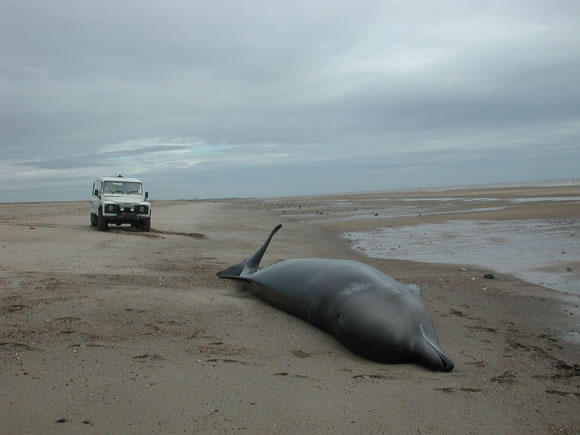
SW2006/236.1 Stranded northern bottlenose whale in Skegness, Lincolnshire © CSIP-ZSL
General guidelines and advice on what to do in the event of a stranding can be found here.
You can also download CSIP's PDF guide containing the above numbers plus advice on what to do to report the stranding and possible actions to take
You can also download CSIP's PDF guide containing the above numbers plus advice on what to do to report the stranding and possible actions to take